
Why I STILL Think You Shouldn't Avoid Avoidants
Hello! I got a fire under me to circle back to a blog post from waaaaaay back (that still receives comments) and a more updated version I posted a while ago. I figured it was time to address some of what has bubbled up over the years.
If you'd like to listen instead, you can! Here is the podcast version.
My articles encouraging people to not discriminate against those with the avoidant attachment style are my most read. There are nearly 100 comments on one post and 30 on another, and many say something to the tune of “this post is completely wrong! You absolutely should avoid avoidant people! They are terrible!” Sigh.
I wanted to write a more updated version of this post because I feel even MORE confident than I did all those years ago (nearly a decade for one of them!) that our protective impulses are actually keeping us from our own healing.
Over the course of the past decade, I’ve learned the modality of Internal Family Systems, or parts work. It has brought into focus how our attachment wiring shows up in our relational behaviors. I can see clearly now when a client is operating from a “part” instead of Self, which is what we call the most centered, wise version of a person. Parts are desperately trying to help us figure out how to keep us from being hurt. They know when to jump in because they learned it in real time years ago when we felt the initial hurt or harm. But the trouble is that they are outdated now—their behaviors don’t line up with what is happening in the present moment.
I first read the book Attached in early 2017, right before Heirloom Counseling came to be. I had already been trained in attachment-focused therapy approaches. I remember reading it and feeling deeply confused. What were the authors trying to convey in this work? What were they asking all of us to do? And what I landed on was that at the time, their own unhealed wounds were encouraging readers to stay away from people with the avoidant attachment style.
Therapists are people, too. As clinicians, I believe we have a lot of work to do to become more self-reflective. More on that another time. (P.S. The authors have since shared that they wish they had written the book differently and are able to recognize their own biases now. I appreciate that.)
From the discomfort I felt, I began writing about this concept and advocating for having compassion for people with the avoidant style. I was met with significant push-back that continues today. Here are some of the comments I’ve received over the years (some as recently as last week):
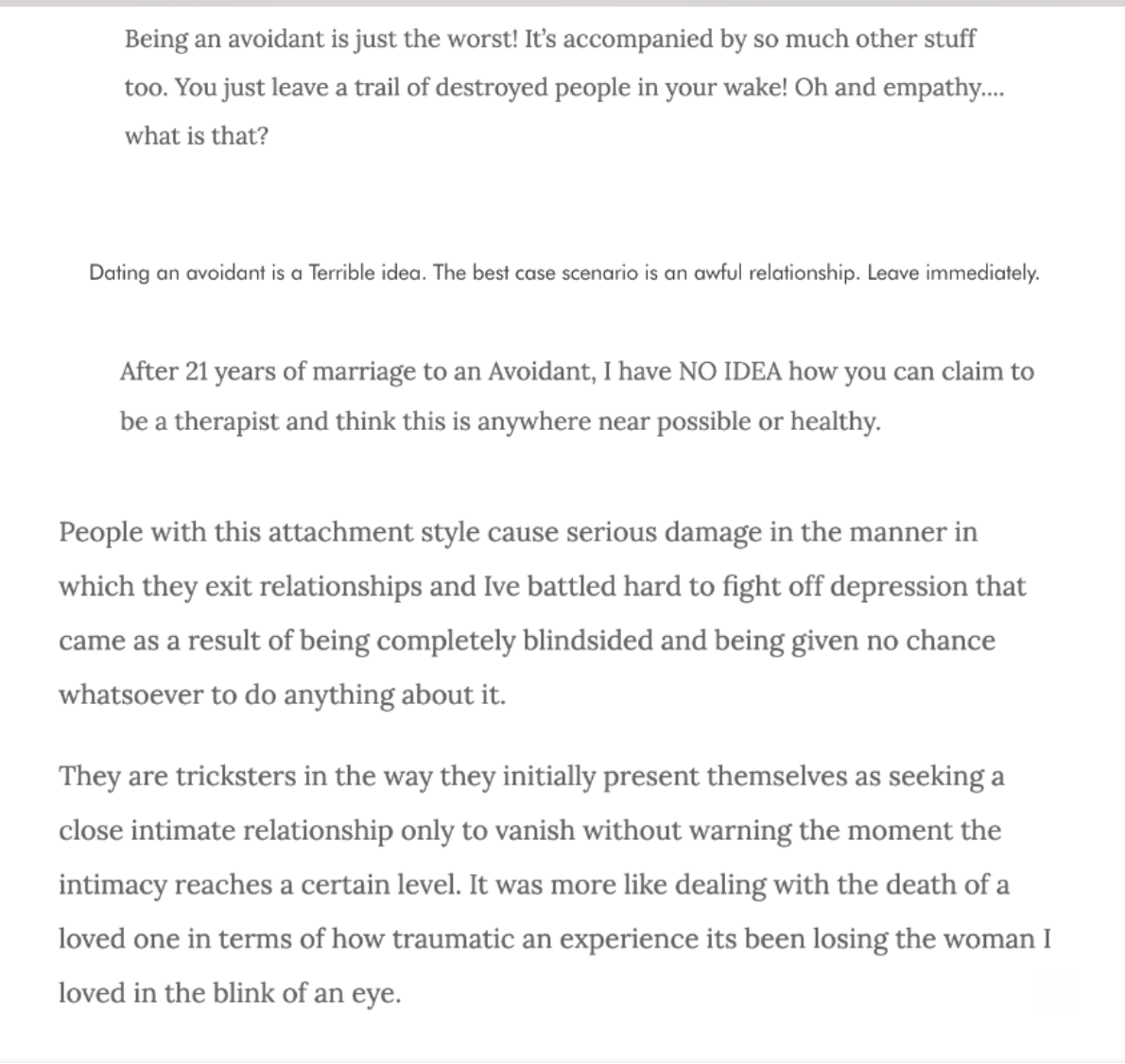
It took a lot of inner work to remind myself that the reactions from these folks were indicative of their challenging life experiences and circumstances (which are real and valid), and a testament to the lack of clear, grounded, balanced resources for navigating attachment differences in relationships. Their parts were activated by what I was communicating—“this is not safe! This will hurt us!” I decided to make it my life’s work to share that we can and should do better in our relationships—not only for ourselves, but for the people we care about and the people who will come after us.
I’m here to double down on what I’ve said already, and clarify just in case there is lingering confusion:
You aren’t having trouble with your partner simply because they are avoidant. Yes, there are difficulties if you are in an anxious-avoidant dynamic. I have been in those kinds of relationships and I understand how frustrating they can be. However, there are plenty of partners who have developed the avoidant attachment style and are actively working to become more secure. I see these people in my therapy and coaching practices daily. To remove the nuance from this aspect and simplify this concept to this degree is irresponsible and uninformed. Avoidant attachment is not narcissism, it’s not abuse, and it’s not giving up on a relationship or not wanting to put any work in. Avoidant attachment is a way of seeing the world and a set of behaviors that has developed over time to increase one’s sense of protection and safety. These skills can be shifted with support, intention, and care.
People with any attachment style can cause relational strife. I look back on the times I was triggered in relationships and let me tell you, my anxious attachment was no walk in the park. I was entitled, demanding, and frankly, difficult to be around. I feel embarrassment about those times and also so much relief that I have learned to feel secure in relationships, set appropriate boundaries, and be confident in who I am.
Even if you date someone who is secure, your OWN patterns can still be triggered—by their security! You may think that being in a relationship with a secure person will mean you aren’t triggered, but I can tell you from personal and professional experience: it’s just not true. In fact, it may amplify the ways in which you are showing up with anxiety (or even avoidance). Security in a relationship does not solve every issue. It is an important and admirable goal (one we can all be working toward), but it’s not only important aspect of relational health.
In my opinion, rejecting someone because they trigger you is an inherently reactive response rooted in relational trauma. Claiming to not interact with anyone who has the avoidant attachment style is a fearful protective mechanism. And it’s okay that you feel that way. But what you do with that fear and worry is your own work, just as avoidant people have theirs. Relational insecurity is based in fear of being hurt, abandoned, or rejected. It’s our worst case scenario as humans and we will go to great lengths to prevent it, even if it means forgoing our relationships and connections.
The most impactful work you can do in your relationship is learning to focus on what YOU are bringing to the dynamic. Even if your partner is “the problem”, they are only one part of the problem. One of the arguments that comes up in the comments is that it’s very difficult to leave an avoidant partner, even if they are terrible to you (which is once again beyond just being avoidant). But why is that? What is happening for you that you can’t or don’t want to leave? What support might you need to shift how you see yourself and find your sense of self-worth so you can be in a relationship that feels respectful for you? You don’t have to be a victim in your relationships or be subject to treatment that feels bad to you. You are a person with agency and choices and you can access support. There are resources and people who want to help if you’re feeling stuck.
I have learned over the course of my career as a therapist how siloed we are becoming in this work. It’s easy to land in an echo chamber of people who agree with you and insist that you are doing everything right in your relationship and the problem is your partner. But what happens when you step outside of that place? Is there anything you might be able to learn about yourself, or anything you might be able to do differently that might change how your relationship feels, how you perceive your partner, or how they perceive you?
And finally: What if we could love the parts of each other that become activated in those difficult moments? What if we could see them clearly and respond to them for who they are—young parts being amplified for protection? What if you could see your avoidant partner in those moments and recognize that asking for more connection is actually scary for them? That doesn’t mean you can’t ask for more connection ever, but that you are not entitled to everything you want in a partnership, regardless of who you are with. You can strive to work together in your relationship and if they are unable to do that with you, then the issue may actually be more than their avoidance.
Let me ask you this: if you are a person who has decided to “avoid avoidant people”, how are your relationships now? Are they going well? Have you escaped relational conflict? I ask these questions from a place of real curiosity because my sense is that you’re still navigating challenges; they just feel different to you. I’m also imagining that ending a relationship with someone you care about simply because they have avoidant behaviors would be really hard. And finally, we all have avoidant parts and I’m not sure how you would screen someone for avoidance at the beginning of a relationship unless it was terribly obvious.
Please don’t fall into the harsh and naive way of categorizing people as being worthy or unworthy of knowing and loving based on what you think their attachment style is. There is so much more for us to work on together, and lots of potential you are missing out on if you choose to live this way.
My hope is that we will continue to deepen our learning and understanding of each other and build our capacity for tolerating discomfort so we can create brave (and safe) spaces for all of us.
I would love to hear what you think. Thank you for reading.
Warmly,
Elizabeth